
• Skip to primary navigation
  • Skip to main content
  • Skip to primary sidebar
  • Skip to footer
InvestSaver

InvestSaver.com

Be an InvestSaver

  • Home
  • Blog
  • About Us
  • Contact Us

What is TAN? Importance, Uses, Application, Status Check & Correction Process

April 2, 2026 by Gaurav

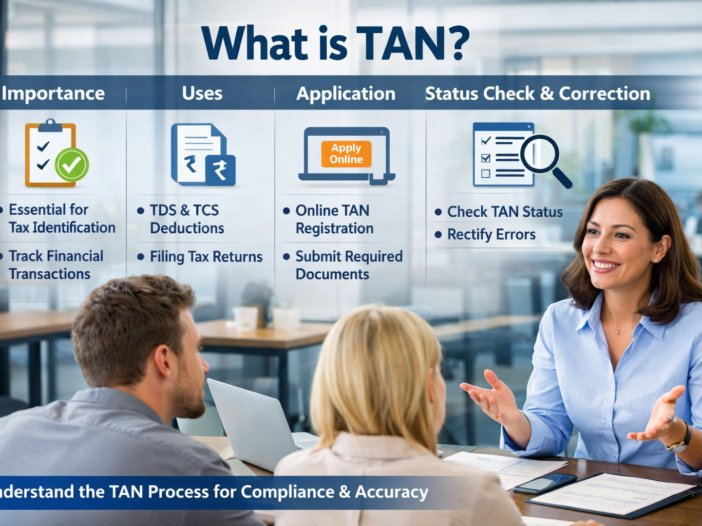
What is TAN?

 Introduction

Many businesses and professionals face confusion when they start deducting tax at source. Without proper registration, you cannot legally deduct or deposit tax. As a result, you may face penalties and compliance issues.

To solve this problem, the government has introduced TAN (Tax Deduction and Collection Account Number). Therefore, you must obtain TAN before handling any TDS or TCS transactions.

 What is TAN?

TAN is a 10-digit alphanumeric number issued by the Income Tax Department.

You must use TAN whenever you:

  • Deduct Tax at Source (TDS)
  • Collect Tax at Source (TCS)

For example: DELX12345A

Importance of TAN

TAN plays a crucial role in tax compliance. Without it, you cannot proceed legally with TDS or TCS.

Therefore, TAN helps you:

  • File TDS/TCS returns accurately
  • Ensure correct tax credit to recipients
  • Maintain transparency in transactions
  • Avoid penalties and notices

If you fail to quote TAN, authorities may impose a penalty of ₹10,000.

Eligibility / Use of TAN

Now, let’s understand who needs TAN and where you must use it.

You must apply for TAN if you:

  • Deduct TDS on salary (Form 130)
  • Deduct TDS on payments like rent, fees, or interest (Form 131)
  • Collect TCS on specified transactions

In addition, you use TAN for:

  • Filing TDS returns
  • Issuing TDS certificates
  • Complying with tax regulations

 Step-by-Step Process to Apply for TAN

You can apply through
Protean eGov Technologies Limited

Step 1: Open Application Portal

Visit:
https://tin.tin.nsdl.com/tan/form49B.html

 Step 2: Fill Form 49B

Enter:

  • Name of applicant
  • Address
  • Contact details
  • AO Code

 Step 3: Submit Application

Carefully verify all details and submit the form.

 Step 4: Pay Fees

Pay ₹65–₹75 using:

  • Net Banking
  • Debit/Credit Card
  • UPI

 Step 5: Generate Acknowledgement

After submission:

  • You will receive a 14-digit acknowledgement number
  • Save it for future use

Step 6: Complete Verification

Choose one:

  • Aadhaar e-sign (fastest)
  • DSC (digital signature)
  • Physical submission

Step 7: Receive TAN

You will receive TAN within:

  • 3–10 working days depending on mode

 Documents Required

Generally, you do not need to upload documents. However, you must provide:

  • Correct name and address
  • Valid contact details
  • Proper signature (if physical mode)

 Fees / Charges

You must pay a nominal fee:

  • ₹65–₹75 for application
  • Additional charges may apply for correction

Mistakes to Avoid

While applying, you should avoid common errors.

Therefore, ensure that you:

  • Do not apply for multiple TANs
  • Enter correct name and details
  • Select correct AO Code
  • Verify information before submission
  • Keep acknowledgement number safe

How to Check TAN Application Status

Visit:
https://tin.tin.nsdl.com/tan/TANStatus.html

Steps:

  1. Enter acknowledgement number
  2. Enter name
  3. Click submit

You can track:

  • Application progress
  • TAN allotment
  • Dispatch status

 TAN Correction Process

If you make any mistake, you can correct it easily.

Visit:
https://tin.tin.nsdl.com/tan/ChangeRequest.html

Steps:

  1. Enter TAN number
  2. Select correction field
  3. Update details
  4. Pay fee
  5. Verify using e-sign, DSC, or physical mode

 FAQs

1. Is TAN mandatory?

Yes, you must obtain TAN if you deduct or collect tax at source.

2. Can I have more than one TAN?

No, you can hold only one TAN per entity.

3. How long does it take to get TAN?

Generally, it takes 3–10 working days.

4. Can I apply TAN without PAN?

Yes, PAN is not mandatory but recommended.

5. Can I correct TAN details later?

Yes, you can apply for correction anytime.

 Conclusion

To conclude, TAN is an essential requirement for TDS and TCS compliance. Moreover, it ensures transparency, proper reporting, and smooth tax filing.

Therefore, you should apply for TAN correctly, track your application regularly, and update details whenever required to avoid penalties and ensure compliance.

Filed Under: Income Tax

Primary Sidebar

Recent Posts

  • Tax Saving Tips for Salaried Individuals
  • What is TAN? Importance, Uses, Application, Status Check & Correction Process
  • ITR Filing Due Date – Financial Year 2025–26 (Assessment Year 2026–27)
  • New Income Tax Act, 2025
  • How to File ITR Online (Step-by-Step Guide)
  • Top Tax Deductions in Every Small Business
  • Financial Planning Tips for Startups and Entrepreneurs
  • Documents Required to File ITR in India?
  • ITR Filing Deadline for Assessment Year (2025–2026)
  • Income Tax Return for Freelancers and Consultants (AY 2025–2026)
Tax Saving Tips for Salaried Individuals

INTRODUCTION As of March 2026, salaried individuals in India enter the critical last phase of tax planning. Since the financial year ends on March 31, this period becomes crucial for finalizing investments and submitting proofs to employers. Therefore, timely action can help reduce excess tax deduction and improve cash flow. Moreover, after the updates introduced […]

What is TAN?

 Introduction Many businesses and professionals face confusion when they start deducting tax at source. Without proper registration, you cannot legally deduct or deposit tax. As a result, you may face penalties and compliance issues. To solve this problem, the government has introduced TAN (Tax Deduction and Collection Account Number). Therefore, you must obtain TAN before handling […]

ITR FILING DUE DATE

Introduction Every taxpayer must understand the Income Tax Return (ITR) filing due dates to ensure timely compliance and avoid penalties. The Income Tax Department prescribes specific deadlines based on the nature of the taxpayer and audit applicability. Therefore, knowing the correct due date for Financial Year 2025–26 (Assessment Year 2026–27) is essential for individuals, professionals, […]

NEW INCOME TAX ACT PICTURE

Introduction As of April 1, 2026, India has implemented one of its most significant tax reforms since independence. The government has repealed the Income Tax Act, 1961 and replaced it with the Income Tax Act, 2025. This reform simplifies tax laws, improves clarity, reduces litigation, and strengthens digital compliance. Now, let’s understand all the major […]

HOW TO FILE ITR RETURN ONLINE

Filing your Income Tax Return (ITR) is a legal responsibility for every eligible individual or entity earning income in India. The good news is, filing ITR has become easy, fast, and can be done completely online. This guide will help you understand how to file ITR online, the step-by-step process, the rules you must follow, […]

TOP TAX DEDUCTIONS EVERY SMALL BUSINESS

For small business owners, every rupee counts. With tight budgets, lean operations, and ever-growing competition, managing finances efficiently is not just smart—it’s necessary. One of the best ways to boost your bottom line is by taking full advantage of available tax deductions. These deductions can significantly lower your taxable income, resulting in major savings. Its […]

FINANCIAL PLAMMING TIPS FOR STARTUP AND ENTPRENEUR

Starting a business is interesting , but also comes with significant a financial challenges. For startups and entrepreneurs, financial planning are not just about survival—it’s about a build foundation for sustainable growth in business. Here are Top Financial Planning Tips for Startups and Entrepreneurs  should consider. 1.Create a Detailed Business Plan Before anything else, develop […]

DOCUMENT FILING RETURN

Filing an Income Tax Return (ITR) is a crucial responsibility for every taxpayer in India. Whether you’re a salaried individual, a freelancer, a business owner, or a senior citizen, filing your ITR helps you report your income, claim deductions, and ensure compliance with tax laws. While the actual return is filed online and does not […]

ITR FILING DEADLINE

As the new financial year begins, taxpayers across India need to gear up for one of the most crucial responsibilities – filing their Income Tax Returns (ITR). The Assessment Year (AY) 2025–2026 corresponds to the Financial Year (FY) 2024–2025, which began on April 1, 2024, and will end on March 31, 2025. Timely filing of […]

INCOME TAXRETUN FOR FREELANCERS AND CONSULTANTS

With the rise of the gig economy and digital entrepreneurship, freelancing and consultancy have become viable career options for many professionals in India. However, one area that often causes confusion is income tax compliance. Here you will find a guide for Income Tax Return for Freelancers and Consultants. Filing an Income Tax Return (ITR) as […]

Footer

Tax Planning

We help you to plan your taxes smartly and efficiently. Our expert tools and guidance ensure you maximize your savings. From deductions to investments, we cover every opportunity. Start early with us and enjoy a stress-free tax season!

Learn more about tax planning

Tax filing

We help you to file your taxes accurately and on time. Our simple and secure platform makes the process effortless. Whether salaried, self-employed, or business owner — we’ve got you covered. File with confidence and get your maximum refund faster!

Learn more about tax filing.

Quick Refunds

Get your tax refund faster with InvestSaver!
Quick processing, accurate filing, and real-time tracking.
No delays, no worries — your money comes back to you sooner.
File today and enjoy a smooth, speedy refund experience!

Learn more about refunds.

Copyright © 2026 · Genesis Sample on Genesis Framework · WordPress · Log in