
• Skip to primary navigation
  • Skip to main content
  • Skip to primary sidebar
  • Skip to footer
InvestSaver

InvestSaver.com

Be an InvestSaver

  • Home
  • Blog
  • About Us
  • Contact Us

ITR Common Mistakes to Avoid

May 14, 2025 by InvestSaver

ITR COMMON MISTAKE TO AVOIDE

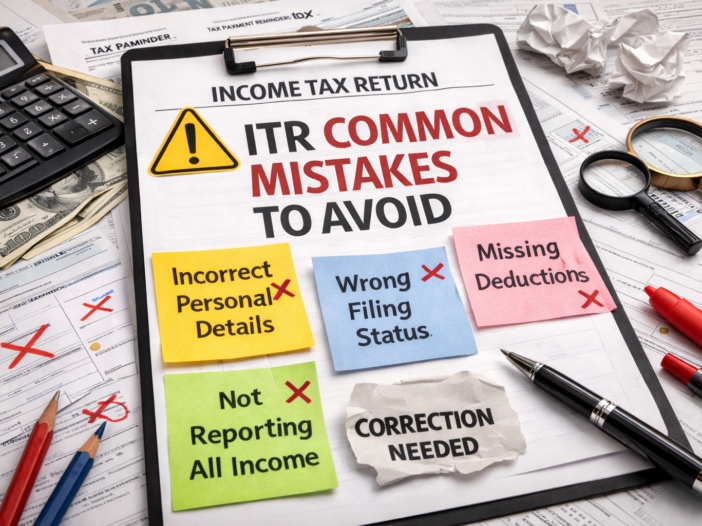
Filing your Income Tax Return (ITR) is not just a legal obligation but also an important part of financial planning. Whether you are a salaried employee, a business owner, or a freelancer, filing your ITR correctly ensures compliance with tax laws and can help you claim refunds, carry forward losses, and secure loans or visas. However, many taxpayers make avoidable errors that can lead to penalties, delays, or scrutiny from the Income Tax Department. Let’s discuss ITR Common Mistakes to be avoided when you are filing your ITR.

  1. Choosing the Wrong ITR Form

One of the most frequent mistakes selecting the incorrect ITR form. The Income Tax Department provides different forms based on income sources, category of taxpayer, and other criteria. Filing with the wrong form can lead to the return being marked as defective or even invalid.

Tip: Use the Income Tax Department’s utility or consult a professional to ensure you are choosing the right form based on your income structure.

  1. Failing to Report All Sources of Income­­­

Many individuals forget to disclose income from interest on savings accounts, fixed deposits, rental income, or capital gains from investments. Omitting these can be considered tax evasion.

Tip: Consolidate all income sources before filing. Form 26AS and the Annual Information Statement (AIS) can help you cross-verify the income reported to the government.

  1. Incorrect Personal Details

Entering incorrect PAN, Aadhaar number, bank account details, or contact information can cause processing delays or failed refunds.

Tip: Double-check are all personal information before submitting your return.

  1. Not Reconciling TDS and Form 26AS

Mismatch between the Tax Deducted at Source (TDS) reported in your ITR and that in Form 26AS can lead to notice from the IT department.

Tip: Always compare the TDS details with your Form 26AS and AIS before filing the return.

  1. Ignoring Exempt Income

Some types of income, like interest from tax-free bonds or agricultural income, are exempt from tax but must still be reported. Non-disclosure can raise red flags.

Tip: Report are all exempt income clearly in the ITR under the appropriate section.

  1. Forgetting to Claim Deductions

Many taxpayers forget to claim deductions under sections like 80C (investments), 80D (medical insurance), and 80G (donations), thus paying more tax than necessary.

Tip: Keep track of all eligible deductions and ensure they’re properly claimed and supported by valid proofs.

  1. Not Verifying the ITR

Filing the return is not the last step—you must verify it within 30 days (as per current rules) either electronically or by sending a signed physical copy to CPC, Bengaluru.

Tip: Use Aadhaar OTP, net banking, or other quick e-verification methods to avoid delays.

  1. Filing After the Due Date

Late filing lead to penalties and loss of certain deductions, and ineligibility to carry forward losses.

Tip: Mark the due date on your calendar and aim to file well in advance to avoid last-minute issues.

  1. Incorrect Disclosure of Foreign Assets or Income

If you have foreign bank accounts or overseas income, it must be disclosed accurately, especially if you’re a resident taxpayer. Failing to do so can attract severe penalties under the Black Money Act.

Tip: Be transparent about all global assets and consult an expert if necessary.

  1. Using Outdated or Unofficial Portals

Some taxpayers mistakenly use outdated software or unverified platforms to file returns, which may not comply with current regulations.

Tip: Always use the official Income Tax e-filing portal or certified software.

Conclusion

Filing your ITR accurately is crucial to maintaining a clean tax record and avoiding unnecessary trouble. Take the time to gather your documents, understand your tax obligations, and avoid these common pitfalls. If you are unsure, it’s always wise to consult a tax professional and avoid ITR Common Mistakes.

Filed Under: Income Tax

Primary Sidebar

Recent Posts

  • Tax Saving Tips for Salaried Individuals
  • What is TAN? Importance, Uses, Application, Status Check & Correction Process
  • ITR Filing Due Date – Financial Year 2025–26 (Assessment Year 2026–27)
  • New Income Tax Act, 2025
  • How to File ITR Online (Step-by-Step Guide)
  • Top Tax Deductions in Every Small Business
  • Financial Planning Tips for Startups and Entrepreneurs
  • Documents Required to File ITR in India?
  • ITR Filing Deadline for Assessment Year (2025–2026)
  • Income Tax Return for Freelancers and Consultants (AY 2025–2026)
Tax Saving Tips for Salaried Individuals

INTRODUCTION As of March 2026, salaried individuals in India enter the critical last phase of tax planning. Since the financial year ends on March 31, this period becomes crucial for finalizing investments and submitting proofs to employers. Therefore, timely action can help reduce excess tax deduction and improve cash flow. Moreover, after the updates introduced […]

What is TAN?

 Introduction Many businesses and professionals face confusion when they start deducting tax at source. Without proper registration, you cannot legally deduct or deposit tax. As a result, you may face penalties and compliance issues. To solve this problem, the government has introduced TAN (Tax Deduction and Collection Account Number). Therefore, you must obtain TAN before handling […]

ITR FILING DUE DATE

Introduction Every taxpayer must understand the Income Tax Return (ITR) filing due dates to ensure timely compliance and avoid penalties. The Income Tax Department prescribes specific deadlines based on the nature of the taxpayer and audit applicability. Therefore, knowing the correct due date for Financial Year 2025–26 (Assessment Year 2026–27) is essential for individuals, professionals, […]

NEW INCOME TAX ACT PICTURE

Introduction As of April 1, 2026, India has implemented one of its most significant tax reforms since independence. The government has repealed the Income Tax Act, 1961 and replaced it with the Income Tax Act, 2025. This reform simplifies tax laws, improves clarity, reduces litigation, and strengthens digital compliance. Now, let’s understand all the major […]

HOW TO FILE ITR RETURN ONLINE

Filing your Income Tax Return (ITR) is a legal responsibility for every eligible individual or entity earning income in India. The good news is, filing ITR has become easy, fast, and can be done completely online. This guide will help you understand how to file ITR online, the step-by-step process, the rules you must follow, […]

TOP TAX DEDUCTIONS EVERY SMALL BUSINESS

For small business owners, every rupee counts. With tight budgets, lean operations, and ever-growing competition, managing finances efficiently is not just smart—it’s necessary. One of the best ways to boost your bottom line is by taking full advantage of available tax deductions. These deductions can significantly lower your taxable income, resulting in major savings. Its […]

FINANCIAL PLAMMING TIPS FOR STARTUP AND ENTPRENEUR

Starting a business is interesting , but also comes with significant a financial challenges. For startups and entrepreneurs, financial planning are not just about survival—it’s about a build foundation for sustainable growth in business. Here are Top Financial Planning Tips for Startups and Entrepreneurs  should consider. 1.Create a Detailed Business Plan Before anything else, develop […]

DOCUMENT FILING RETURN

Filing an Income Tax Return (ITR) is a crucial responsibility for every taxpayer in India. Whether you’re a salaried individual, a freelancer, a business owner, or a senior citizen, filing your ITR helps you report your income, claim deductions, and ensure compliance with tax laws. While the actual return is filed online and does not […]

ITR FILING DEADLINE

As the new financial year begins, taxpayers across India need to gear up for one of the most crucial responsibilities – filing their Income Tax Returns (ITR). The Assessment Year (AY) 2025–2026 corresponds to the Financial Year (FY) 2024–2025, which began on April 1, 2024, and will end on March 31, 2025. Timely filing of […]

INCOME TAXRETUN FOR FREELANCERS AND CONSULTANTS

With the rise of the gig economy and digital entrepreneurship, freelancing and consultancy have become viable career options for many professionals in India. However, one area that often causes confusion is income tax compliance. Here you will find a guide for Income Tax Return for Freelancers and Consultants. Filing an Income Tax Return (ITR) as […]

Footer

Tax Planning

We help you to plan your taxes smartly and efficiently. Our expert tools and guidance ensure you maximize your savings. From deductions to investments, we cover every opportunity. Start early with us and enjoy a stress-free tax season!

Learn more about tax planning

Tax filing

We help you to file your taxes accurately and on time. Our simple and secure platform makes the process effortless. Whether salaried, self-employed, or business owner — we’ve got you covered. File with confidence and get your maximum refund faster!

Learn more about tax filing.

Quick Refunds

Get your tax refund faster with InvestSaver!
Quick processing, accurate filing, and real-time tracking.
No delays, no worries — your money comes back to you sooner.
File today and enjoy a smooth, speedy refund experience!

Learn more about refunds.

Copyright © 2026 · Genesis Sample on Genesis Framework · WordPress · Log in