
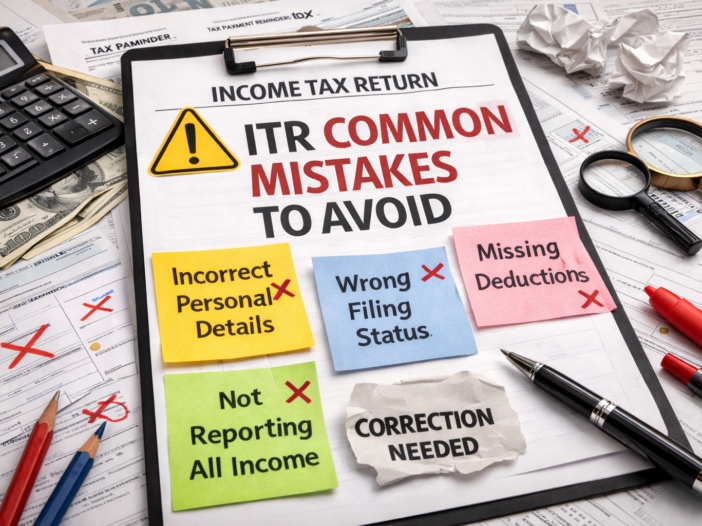
Filing your Income Tax Return (ITR) is not just a legal obligation but also an important part of financial planning. Whether you are a salaried employee, a business owner, or a freelancer, filing your ITR correctly ensures compliance with tax laws and can help you claim refunds, carry forward losses, and secure loans or visas. However, many taxpayers make avoidable errors that can lead to penalties, delays, or scrutiny from the Income Tax Department. Let’s discuss ITR Common Mistakes to be avoided when you are filing your ITR.
- Choosing the Wrong ITR Form
One of the most frequent mistakes selecting the incorrect ITR form. The Income Tax Department provides different forms based on income sources, category of taxpayer, and other criteria. Filing with the wrong form can lead to the return being marked as defective or even invalid.
Tip: Use the Income Tax Department’s utility or consult a professional to ensure you are choosing the right form based on your income structure.
- Failing to Report All Sources of Income
Many individuals forget to disclose income from interest on savings accounts, fixed deposits, rental income, or capital gains from investments. Omitting these can be considered tax evasion.
Tip: Consolidate all income sources before filing. Form 26AS and the Annual Information Statement (AIS) can help you cross-verify the income reported to the government.
- Incorrect Personal Details
Entering incorrect PAN, Aadhaar number, bank account details, or contact information can cause processing delays or failed refunds.
Tip: Double-check are all personal information before submitting your return.
- Not Reconciling TDS and Form 26AS
Mismatch between the Tax Deducted at Source (TDS) reported in your ITR and that in Form 26AS can lead to notice from the IT department.
Tip: Always compare the TDS details with your Form 26AS and AIS before filing the return.
- Ignoring Exempt Income
Some types of income, like interest from tax-free bonds or agricultural income, are exempt from tax but must still be reported. Non-disclosure can raise red flags.
Tip: Report are all exempt income clearly in the ITR under the appropriate section.
- Forgetting to Claim Deductions
Many taxpayers forget to claim deductions under sections like 80C (investments), 80D (medical insurance), and 80G (donations), thus paying more tax than necessary.
Tip: Keep track of all eligible deductions and ensure they’re properly claimed and supported by valid proofs.
- Not Verifying the ITR
Filing the return is not the last step—you must verify it within 30 days (as per current rules) either electronically or by sending a signed physical copy to CPC, Bengaluru.
Tip: Use Aadhaar OTP, net banking, or other quick e-verification methods to avoid delays.
- Filing After the Due Date
Late filing lead to penalties and loss of certain deductions, and ineligibility to carry forward losses.
Tip: Mark the due date on your calendar and aim to file well in advance to avoid last-minute issues.
- Incorrect Disclosure of Foreign Assets or Income
If you have foreign bank accounts or overseas income, it must be disclosed accurately, especially if you’re a resident taxpayer. Failing to do so can attract severe penalties under the Black Money Act.
Tip: Be transparent about all global assets and consult an expert if necessary.
- Using Outdated or Unofficial Portals
Some taxpayers mistakenly use outdated software or unverified platforms to file returns, which may not comply with current regulations.
Tip: Always use the official Income Tax e-filing portal or certified software.
Conclusion
Filing your ITR accurately is crucial to maintaining a clean tax record and avoiding unnecessary trouble. Take the time to gather your documents, understand your tax obligations, and avoid these common pitfalls. If you are unsure, it’s always wise to consult a tax professional and avoid ITR Common Mistakes.